

Domestic Violence Act 2005 (DV Act): Protection, Residence, Money and Custody Orders
The short answer
- The Domestic Violence Act is mainly a civil law. It is designed to protect you and give you practical help, not only to punish the abuser.
- Domestic violence is not only physical. Constant insults, threats, controlling your money and refusing to pay for household needs can all count.
- You can stay in your marital home even if it is owned by your in-laws, and you can still use the DV Act if you have already left.
- One application can ask for several orders at once: protection, residence, money, custody of your children and compensation.
- Urgent orders are possible. The court can act within days, and in serious cases before the other side is even heard.
The rest of this guide explains each of these in turn.
If you are in danger right now: call 112 for the police or 181, the national women’s helpline.
A common worry
“My husband says that because I have already left the matrimonial home, I cannot approach the court under the Domestic Violence Act. Is that true?”
“No. The DV Act is not limited to violence happening inside the house on the day you file. If you lived together in a domestic relationship at any point, you can usually still apply. You can ask for protection, a place to live, financial help and custody of your children.”
1. What is the Domestic Violence Act?
The Protection of Women from Domestic Violence Act, 2005, usually called the DV Act, is India’s main law for women facing abuse at home. Parliament passed it in 2005, and it came into force on 26 October 2006.
Most laws against domestic violence focus on punishing the abuser. The Domestic Violence Act 2005 is different. It is mainly a civil law, built to answer the practical questions a woman faces when home is no longer safe:
- Where will I live?
- How will I pay for things?
- How do I stop the abuse?
- What happens to my children?
The details of how the Act works, including the forms used, are set out in the Protection of Women from Domestic Violence Rules, 2006.
2. What counts as domestic violence? (Section 3)
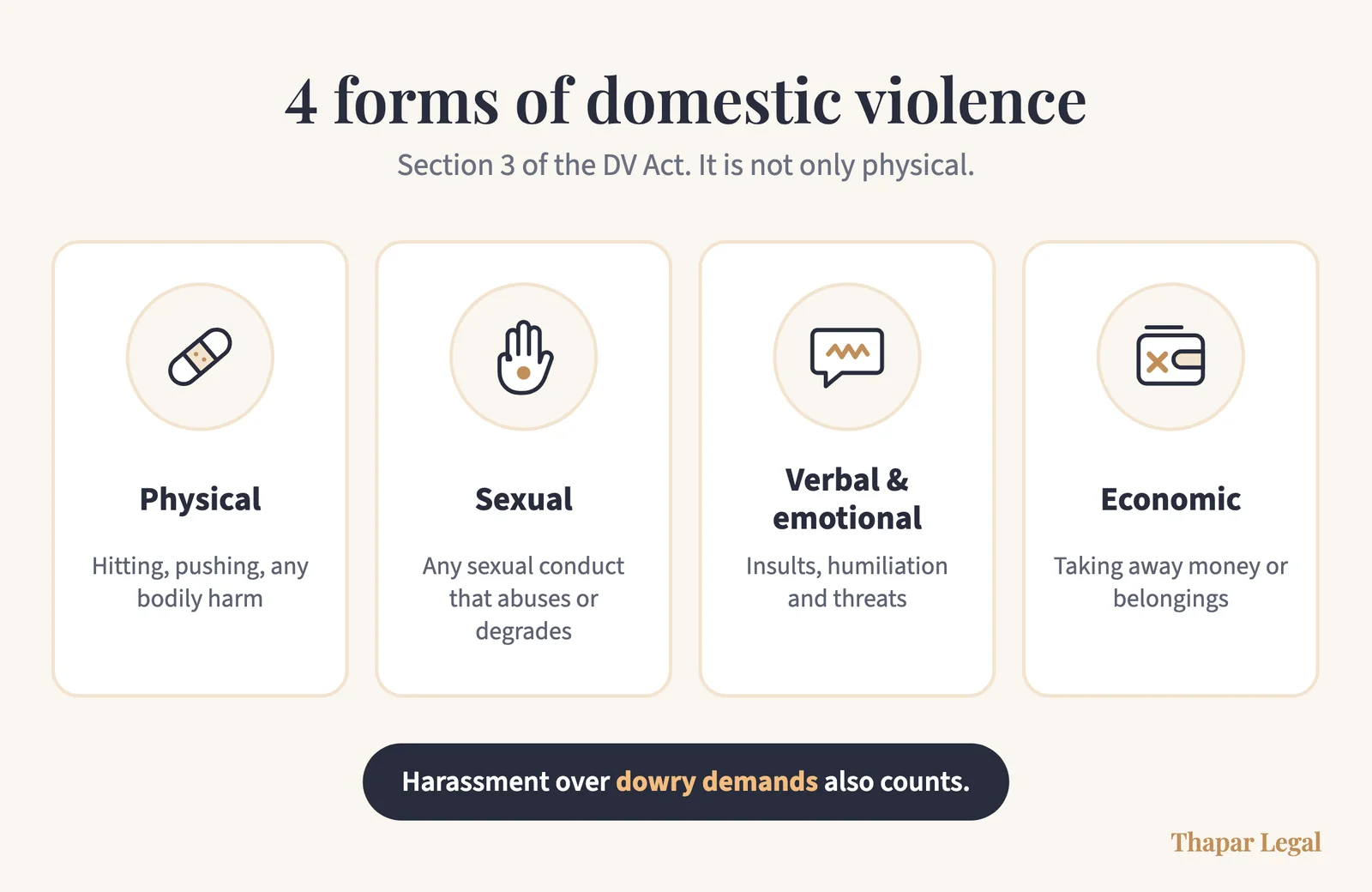
Section 3 of the Domestic Violence Act defines domestic violence widely. It covers:
- Physical abuse: hitting, pushing, or any act that causes bodily pain or harm.
- Sexual abuse: any sexual conduct that abuses, humiliates or degrades you.
- Verbal and emotional abuse: insults, name-calling, humiliation and threats, including taunts about not having a child or a son.
- Economic abuse: taking away money you need, stopping you using household things, or selling off your belongings or shared property.
Harassment over dowry demands also counts as domestic violence under Section 3.
“My husband has never hit me. But he constantly humiliates me, controls my finances, threatens to throw me out and refuses to give money for household expenses.”
“That can still be domestic violence. The DV Act covers verbal, emotional and economic abuse, not just physical assault. The court will look at the facts and the evidence you can show.”
3. Who can use the DV Act?
Who can apply
The DV Act protects an “aggrieved person”: a woman in a domestic relationship who says she has faced domestic violence. A domestic relationship means you live, or have at some point lived, in the same household as the other person, and you are related through:
- marriage;
- a relationship in the nature of marriage, such as a long-term live-in relationship;
- blood or adoption; or
- living together as a joint family.
In Prabha Tyagi v. Kamlesh Devi (2022), the Supreme Court made clear that the relationship can be in the past. You do not need to be living with the abuser when you apply. Separating does not take away your right to use the Domestic Violence Act.
Who a case can be filed against
The case is filed against the “respondent”. The Act originally said this must be an adult man. In Hiral P. Harsora v. Kusum Narottamdas Harsora (2016), the Supreme Court removed that limit. A case can now be filed against women relatives too, such as a mother-in-law or sister-in-law.
4. What orders can the court give? (Sections 17 to 23)
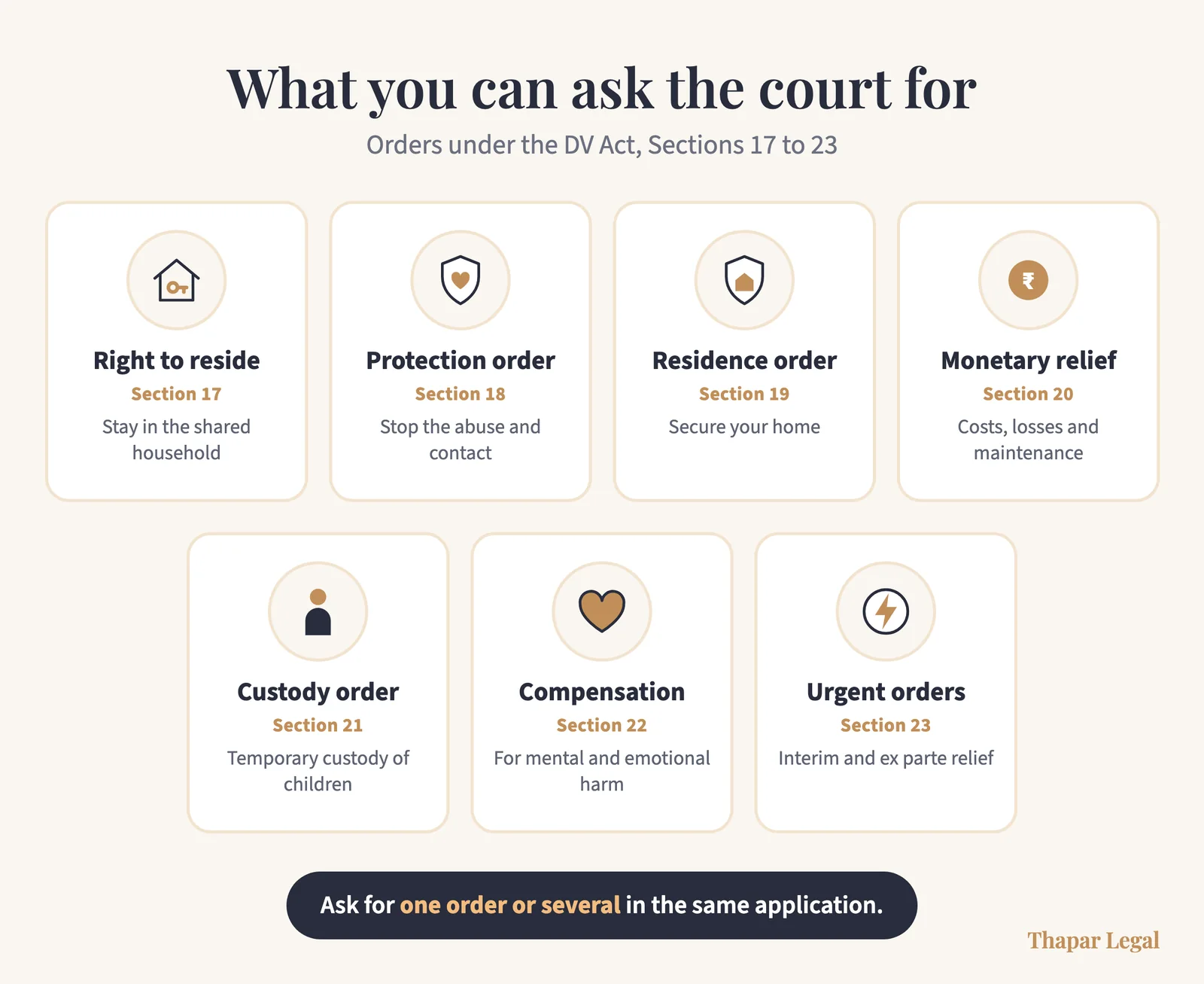
The Domestic Violence Act does not offer just one remedy. Depending on what you need, you can ask for:
- Right to live in the shared household: Section 17
- Protection order: Section 18
- Residence order: Section 19
- Monetary relief: Section 20
- Custody order: Section 21
- Compensation order: Section 22
- Urgent interim and ex parte orders: Section 23
You can ask for one of these or several together. A strong case starts by working out what you actually need, rather than filing a general complaint about abuse. The next sections explain each order.
5. Protection orders under the Domestic Violence Act (Section 18)
A protection order tells the abuser to stop. The court can grant one if it is satisfied that domestic violence has happened or is likely to happen. Depending on the facts, it can stop the respondent from:
- committing any act of domestic violence;
- helping anyone else commit domestic violence;
- entering your workplace, your children’s school or other places you go;
- contacting you by phone, message, email or in person;
- selling or transferring property or assets, in appropriate cases; or
- doing anything else the order specifically prohibits.
“My husband keeps calling me, threatening me and coming to my workplace. I’m afraid things will get worse.”
“A protection order can address exactly this. Your application should set out what he did, when and where it happened, and what protection you need, for example no contact and staying away from your office.”
Breaking a protection order is a criminal offence under Section 31 of the DV Act.
6. Your right to live in the shared household (Section 17)
Where you will live is often the most urgent question. Section 17 of the Domestic Violence Act gives you the right to live in the “shared household”, the home you lived in during the relationship. You cannot be thrown out of it except through a proper legal process.
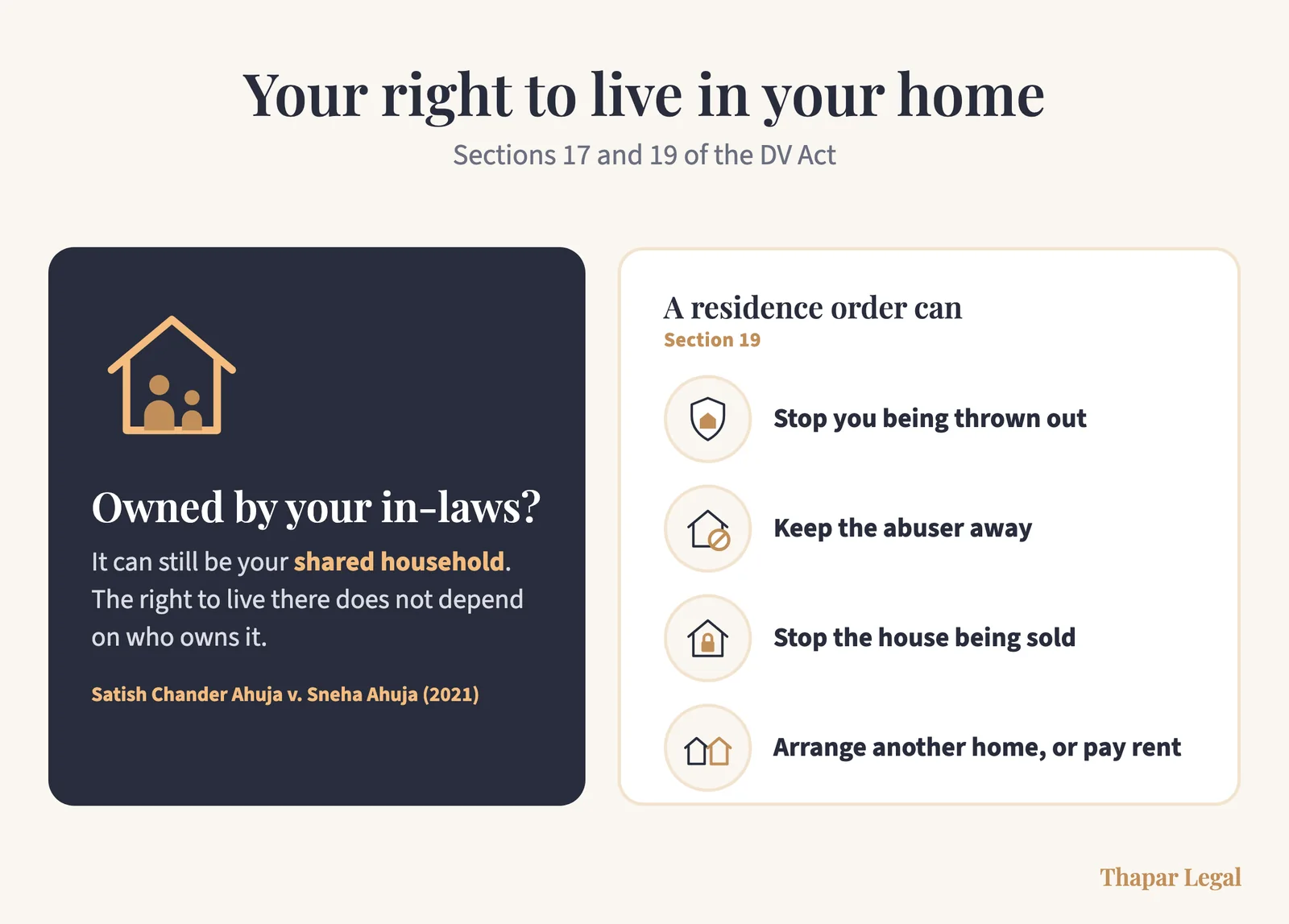
This right does not depend on who owns the house. In Satish Chander Ahuja v. Sneha Ahuja (2021), the Supreme Court held that a shared household can include your in-laws’ home, even if neither you nor your husband owns it.
“The house is registered in my father-in-law’s name. Does that mean I have no right to live there?”
“Not automatically. Who owns the house and whether you can live there are separate questions. The court first decides whether the house was your shared household under the DV Act.”
7. Residence orders (Section 19)
Section 19 lets the court make orders about your home. Depending on the facts, it can:
- stop anyone from throwing you out of the shared household;
- order the respondent to stay away from part of the house, or from the house altogether (this particular order cannot be made against a woman);
- stop the house from being sold or mortgaged; or
- order the respondent to arrange other accommodation for you, of the same standard as the shared household, or to pay rent for it.
So a residence order does not always mean you stay in the same house. The court can decide that suitable alternative accommodation protects you better.
8. Monetary relief (Section 20)
Domestic violence often costs money. Section 20 of the Domestic Violence Act lets the court order the respondent to pay for:
- lost earnings;
- medical expenses;
- damage to or loss of property; and
- maintenance for you and your children.
The court can order a single payment or monthly payments.
For example: if you had to take leave from work because of the violence, paid for medical treatment, and were left without support, your application should list each of these costs with proof, such as salary slips, leave records and medical bills. A one-line request for “maintenance” is much weaker.
Maintenance can also be claimed under other laws. Our guide to maintenance for wife and children in India explains how courts decide the amount.
9. Child custody (Section 21)
Section 21 lets the court give you temporary custody of your children and set visiting arrangements for the other parent. The court can refuse visits if they could harm the child.
The DV Act does not change the basic rule that the welfare of the child comes first. You can read how courts apply that rule in our guide to child custody laws in India.
A custody request under the Domestic Violence Act should explain:
- where the child lives now and who looks after them day to day;
- the child’s school and medical needs;
- the child’s relationship with each parent;
- the immediate concern that needs the court’s help; and
- what arrangement you propose.
10. Compensation for mental torture and emotional distress (Section 22)
Section 22 of the Domestic Violence Act lets the court order compensation for the harm caused by domestic violence, including mental torture and emotional distress.
Compensation is different from maintenance. Maintenance helps you meet your living costs. Compensation recognises the harm done to you by the abuse itself.
11. Urgent help: interim and ex parte orders (Section 23)
Cases take time, and some situations cannot wait. Section 23 lets the court make temporary (interim) orders while the case runs. In serious cases, the court can even act ex parte, meaning before hearing the other side, based on your sworn statement.
“My child is with my husband and I’m not being allowed to see them. I can’t wait for the whole case to finish.”
“You can ask for an interim order. Your application should say exactly what you need now, such as temporary custody or contact, and why it cannot wait. The court can give interim protection, residence, money or custody orders.”
12. How to file a domestic violence case: step by step
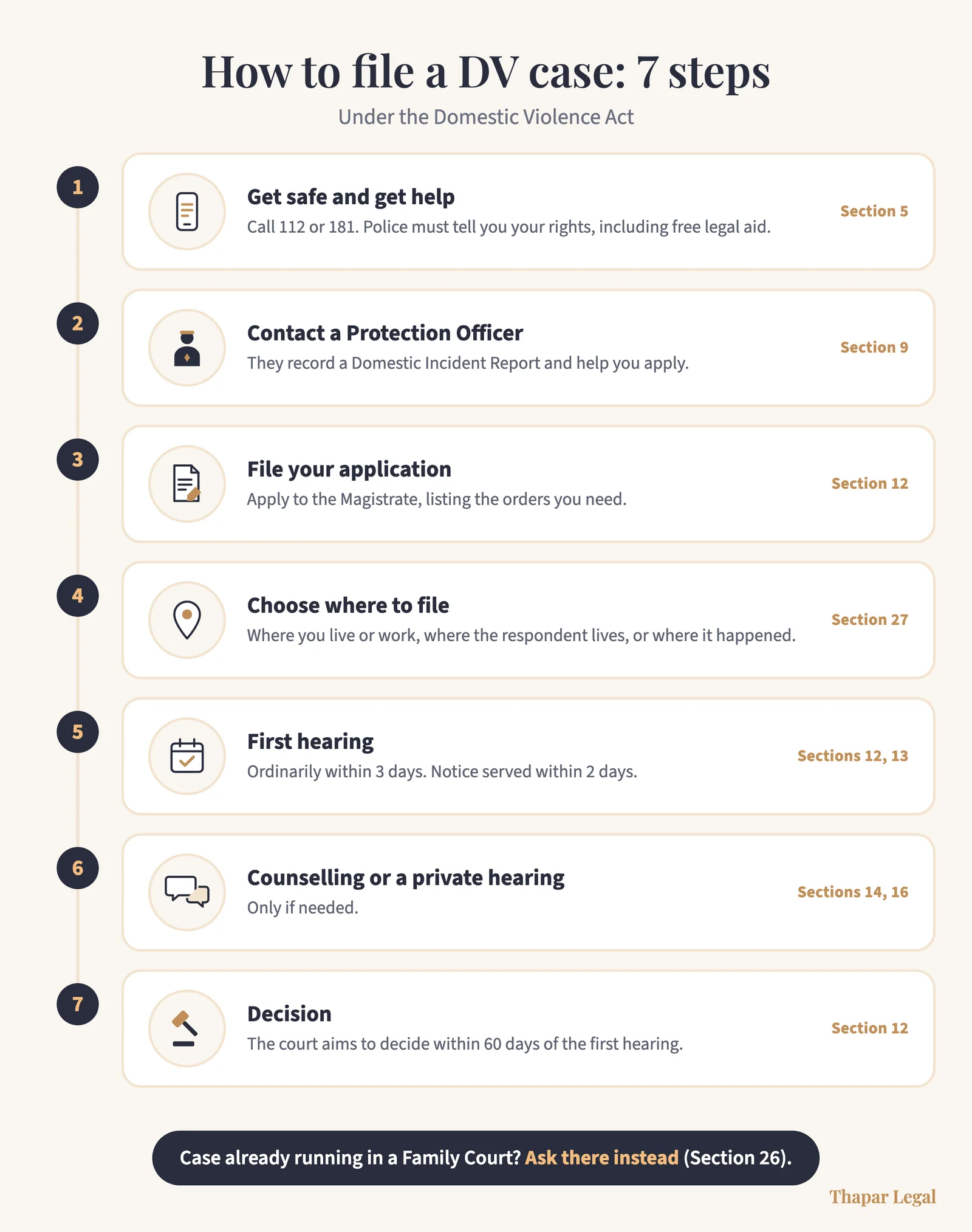
Step 1: Get safe and get help. In an emergency, call 112. Under Section 5, the police, the Protection Officer or the Magistrate must tell you your rights, including your right to free legal aid. Anyone who knows about the abuse, such as a neighbour or relative, can report it to a Protection Officer under Section 4.
Step 2: Contact a Protection Officer. Every district has Protection Officers appointed under the Act. Under Section 9, they help you record a Domestic Incident Report (DIR), file your application, get free legal aid and, if needed, find a shelter home or medical help. Registered service providers, usually NGOs, can also record a DIR (Section 10).
Step 3: File your application under Section 12. You, the Protection Officer, or someone on your behalf can file an application to the Magistrate under Section 12 of the Domestic Violence Act. It should list the orders you want. The Magistrate also looks at the Domestic Incident Report. The forms are set out in the Domestic Violence Rules, 2006.
Step 4: Choose where to file (Section 27). You can file before the Magistrate in the area where:
- you live, even temporarily, or work;
- the respondent lives or works; or
- the domestic violence happened.
If a divorce, maintenance or other case is already running between you, you can ask that court, including a Family Court, for the same orders under Section 26 instead.
Step 5: First hearing and notice. The first hearing should ordinarily take place within 3 days of the Magistrate receiving the application. Notice is usually served on the respondent within 2 days (Section 13).
Step 6: Counselling and private hearings, if needed. The court can direct counselling (Section 14) and can hold hearings privately if either side asks (Section 16).
Step 7: Decision. The Act asks the court to try to decide the case within 60 days of the first hearing. You get copies of the orders free of charge (Section 24). Orders stay in force until the court changes or cancels them (Section 25).
13. Do you have to leave the home before going to court?
No. The right to live in the shared household exists precisely because home can become a battleground. At the same time, a woman who has already left does not lose her rights under the DV Act. As the Supreme Court explained in Satish Chander Ahuja and Prabha Tyagi, you do not need to be living under the same roof on the day you file.
14. What evidence should you keep?
Domestic violence cases are decided on what you can show the court. Depending on what happened, useful evidence includes:
About the abuse
- medical records and photographs of injuries;
- messages, emails and call records showing threats or harassment;
- police complaints and earlier legal notices.
About money and work
- bank statements and salary records;
- proof of household expenses;
- travel or employment records, such as leave taken.
About your home and children
- property documents and proof of where you lived;
- your children’s school and medical records.
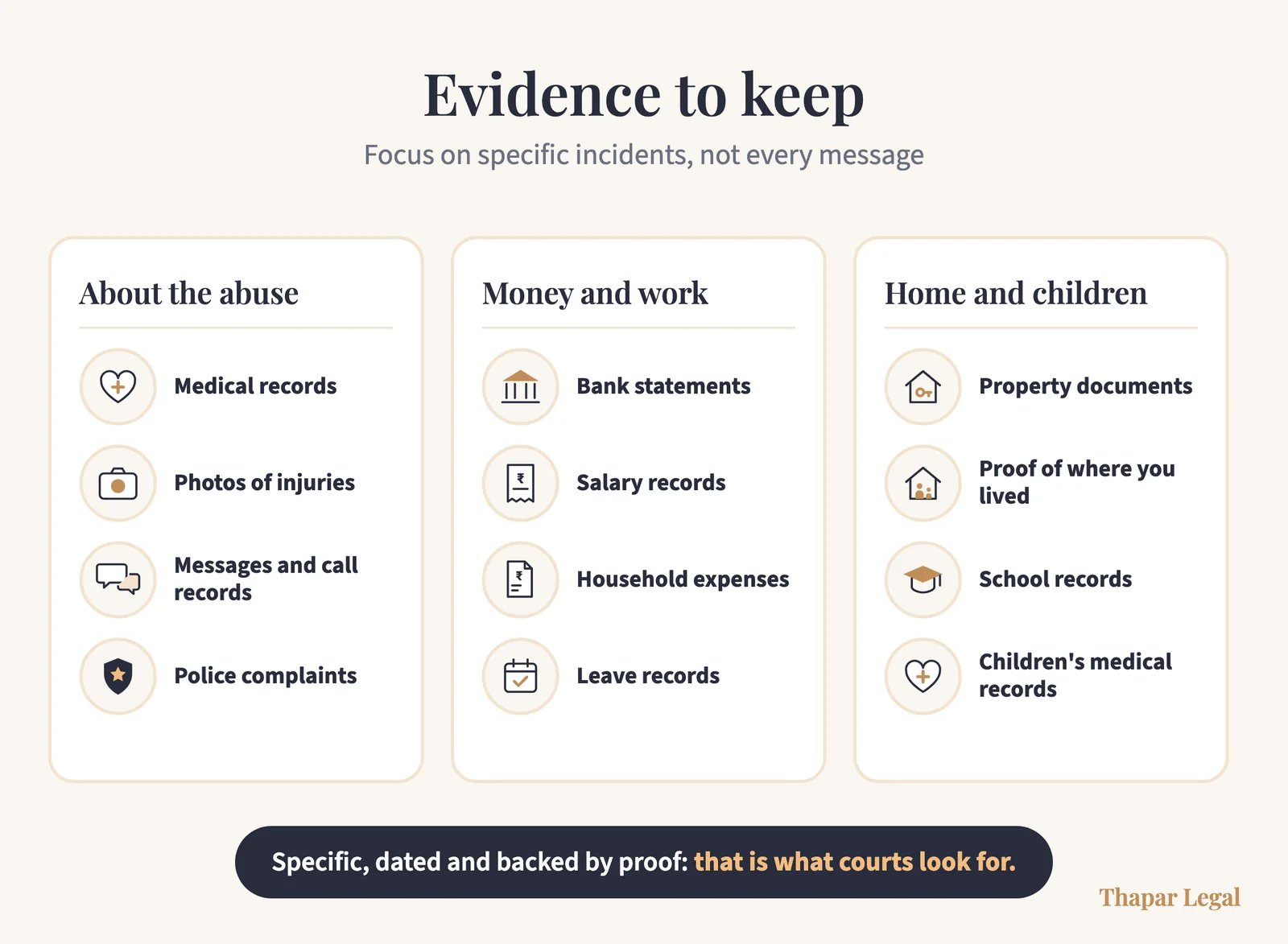
You do not need to collect every unpleasant message from the marriage. Focus on evidence that shows specific incidents, when they happened, what they caused, and what order you are asking for.
15. What makes a complaint under the DV Act strong?
Name what each person did. If you name several family members, explain what each one did. “Respondent No. 2 threatened me on 4 March and 12 April” is far stronger than “all of them harassed me”, especially if some relatives live elsewhere.
Show that it is domestic violence, not ordinary disagreement. Every marriage has arguments. The Domestic Violence Act does not turn every unhappy moment into domestic violence. The court checks whether the conduct fits the definition in Section 3, and a dispute alone does not prove every allegation true.
The strongest applications are specific, in date order, based on facts, backed by evidence, and clear about which orders are being asked for.
16. DV Act sections at a glance
The Domestic Violence Act has 37 sections in five chapters. Here is what each section does.
Chapter I: Preliminary
- Section 1: The Act’s name, where it applies and when it came into force.
- Section 2: Definitions of key terms, such as aggrieved person, domestic relationship, shared household and respondent.
Chapter II: Domestic violence
- Section 3: What counts as domestic violence: physical, sexual, verbal and emotional, and economic abuse, including dowry harassment.
Chapter III: Protection Officers, service providers and other support
- Section 4: Anyone can report domestic violence to a Protection Officer, and is protected when doing so in good faith.
- Section 5: Police, Protection Officers, service providers and Magistrates must tell the woman her rights, including free legal aid.
- Section 6: Shelter homes must give shelter when asked.
- Section 7: Hospitals and medical facilities must give medical help when asked.
- Section 8: State Governments appoint Protection Officers.
- Section 9: Duties of Protection Officers, including preparing the Domestic Incident Report.
- Section 10: Registration and role of service providers, usually NGOs.
- Section 11: Duties of the Government, including publicity and training.
Chapter IV: How to get orders
- Section 12: The application to the Magistrate, and the 3-day and 60-day timelines.
- Section 13: Serving notice on the respondent.
- Section 14: Counselling.
- Section 15: The court can take help from a welfare expert.
- Section 16: Hearings can be held privately.
- Section 17: The right to live in the shared household.
- Section 18: Protection orders.
- Section 19: Residence orders.
- Section 20: Monetary relief.
- Section 21: Custody orders.
- Section 22: Compensation orders.
- Section 23: Interim and ex parte orders.
- Section 24: Free copies of orders.
- Section 25: How long orders last and how they can be changed.
- Section 26: The same orders can be asked for in other court cases, including in a Family Court.
- Section 27: Which court to approach.
- Section 28: The procedure the court follows.
- Section 29: Appeal to the Sessions Court within 30 days.
Chapter V: Miscellaneous
- Section 30: Protection Officers count as public servants.
- Section 31: Punishment for breaking a protection order.
- Section 32: That offence is cognizable and non-bailable.
- Section 33: Penalty for a Protection Officer who fails in their duty.
- Section 34: Prosecuting a Protection Officer needs government permission.
- Section 35: Protection for actions taken in good faith.
- Section 36: The DV Act works alongside other laws, not in place of them.
- Section 37: The Central Government’s power to make rules.
You can read the full bare Act of the Protection of Women from Domestic Violence Act, 2005 on India Code, the Government of India’s official legal database.
Frequently asked questions about the Domestic Violence Act
When was the Domestic Violence Act passed?
Parliament passed the Protection of Women from Domestic Violence Act in 2005. It came into force on 26 October 2006.
Is there any punishment under the Domestic Violence Act?
Yes, for breaking a protection order. Under Section 31, a respondent who breaks one can face up to one year in prison, a fine of up to ₹20,000, or both. The offence is cognizable and non-bailable (Section 32).
What is Section 12 of the Domestic Violence Act?
Section 12 is how a case starts. It lets you, a Protection Officer or someone on your behalf apply to the Magistrate for orders under the Act.
What are Sections 18 to 22 of the Domestic Violence Act?
They are the main orders: protection orders (18), residence orders (19), monetary relief (20), custody orders (21) and compensation orders (22).
Can a DV case be filed against my mother-in-law?
Yes. Since the Supreme Court’s decision in Hiral Harsora (2016), women relatives can be named in a case under the Domestic Violence Act.
Is there a time limit for filing under the DV Act?
The Supreme Court held in Kamatchi v. Lakshmi Narayanan (2022) that the usual time limit does not apply to an application under Section 12. It is still better to apply as early as possible, while the evidence is fresh.
What are the Domestic Violence Rules?
The Protection of Women from Domestic Violence Rules, 2006 set out how the Act works in practice, including the forms for the Domestic Incident Report and the application.
What to do next
The Domestic Violence Act is often misunderstood as just another criminal law. In fact, it gives a woman practical ways to protect herself, stay in her home, meet her expenses, keep her children safe and be compensated for the harm done.
If you are facing domestic violence, start with five questions:
- Where will I live?
- How will I meet my expenses?
- How will I protect my children?
- How can I stop the harassment?
- What happens to my financial security?
The DV Act has a specific order for each of them. A well-prepared application explains what happened, names what each person did, and asks for exactly the orders you need. Speaking to an experienced matrimonial dispute lawyer early can help you get it right the first time.
Talk it through with us
Tell us what’s happening. We’ll explain your options in plain words.
This guide is general information about Indian law, not legal advice for your situation. Every case depends on its own facts.