

Maintenance for Wife and Children in India: Your Rights, Alimony Laws and How the Amount Is Decided
The short answer
- You can ask for maintenance even if you are educated or working. What matters is whether your own income is enough to live on reasonably.
- There is no fixed percentage of salary. The court looks at both spouses’ money, needs and responsibilities.
- Children have their own right to maintenance. It doesn’t depend on who is right or wrong in the marriage.
- Maintenance is usually paid from the day you file your application, not the day the court finally decides.
- You can use more than one law, but you can’t be paid twice for the same thing.
The rest of this guide explains each of these in turn.
A common worry
“My husband earns far more than me. He says I’m not entitled to maintenance because I’m educated and can work. Is he right?”
“Not necessarily. Maintenance isn’t a reward for being unemployed. It also isn’t a fixed share of your spouse’s salary. The court looks at both of your finances, your reasonable needs, the life you had together and your children’s needs. Then it decides whether maintenance is payable and how much.”
1. What maintenance is, and what it isn’t
Maintenance is money one spouse pays to support the other, and their children, after a marriage breaks down.
Its purpose is simple. Nobody should be left without enough to live on because their marriage ended.
It is not a punishment for the spouse who pays. It also doesn’t guarantee a particular lifestyle, whatever the circumstances.
The court tries to reach a fair, realistic amount based on both people’s situations. Every case is decided on its own facts.
2. Which laws let you claim maintenance?
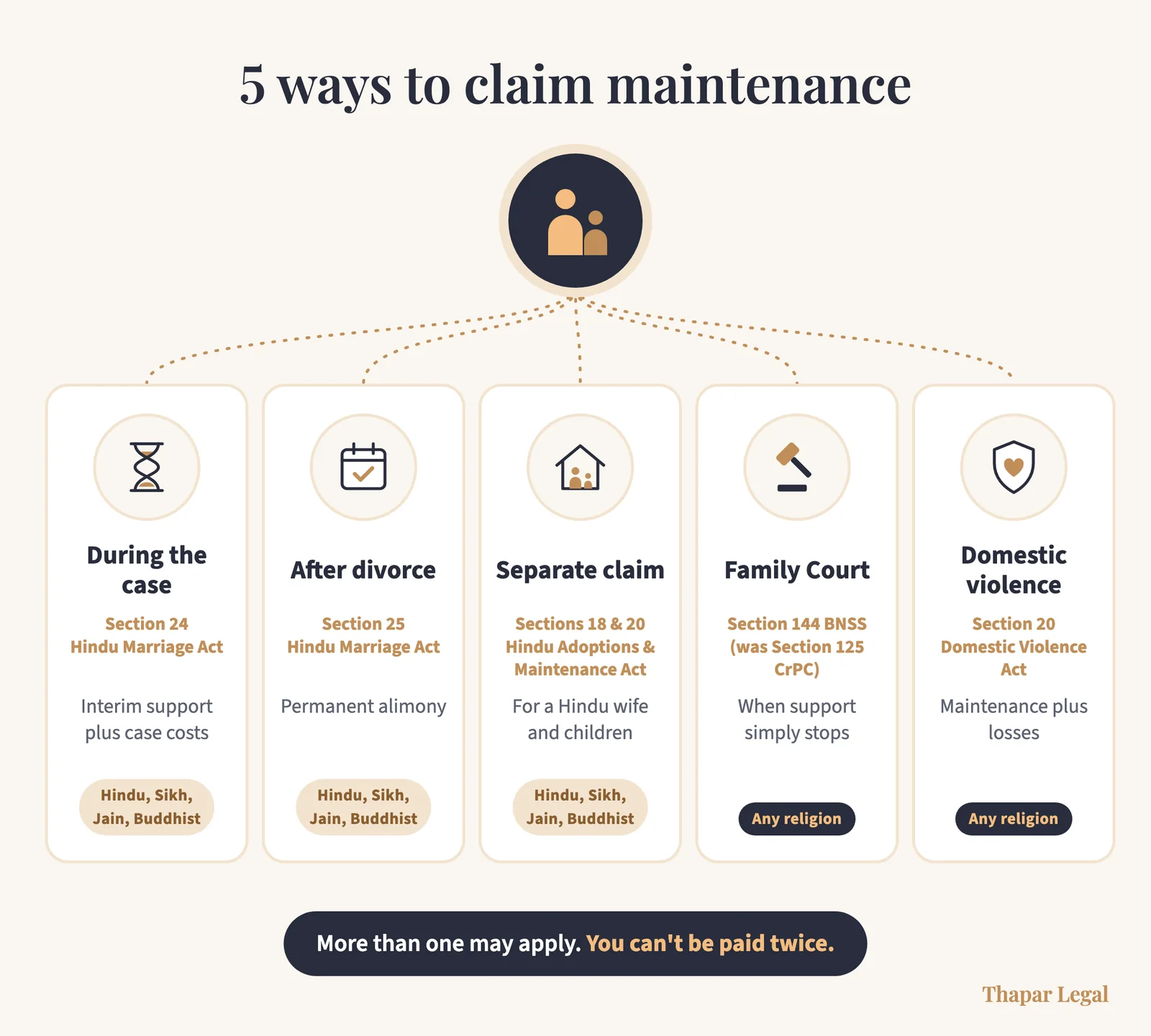
India’s alimony laws are not in one single place. There are several routes, and more than one may apply to you:
- During a divorce case: Section 24 of the Hindu Marriage Act
- When the divorce is decided, or later: Section 25 of the Hindu Marriage Act
- As a separate claim for a Hindu wife and children: the Hindu Adoptions and Maintenance Act
- A direct claim before the Family Court: Section 144 of the BNSS (this used to be Section 125 CrPC)
- Where there is domestic violence: Section 20 of the Domestic Violence Act
The two Hindu Marriage Act routes and the Hindu Adoptions and Maintenance Act apply to Hindus, Sikhs, Jains and Buddhists. Section 144 BNSS and the Domestic Violence Act apply whatever your religion.
Here is what each one does.
Section 24 of the Hindu Marriage Act: support while the case is going on
Divorce cases can take a long time. Section 24 lets a spouse ask for money to live on while the case is ongoing. This is called interim maintenance. Lawyers sometimes call it maintenance “pendente lite”, which simply means “while the case is pending”.
It can also cover the cost of the case itself, such as lawyer’s fees.
Either spouse can ask for it, husband or wife. What matters is whether you have enough income of your own to support yourself and pay for the case.
“I’ve filed for divorce, but my salary barely covers my basic expenses. I can’t afford the case.”
“You may be able to ask for interim maintenance and case expenses under Section 24. The court will look at your income and at your spouse’s finances.”
Section 25 of the Hindu Marriage Act: permanent alimony
Section 24 covers the time while the case is running. Section 25 covers what happens after.
It deals with permanent alimony: the long-term financial arrangement between spouses under India’s alimony laws. The court can order it when it grants the divorce, or later. It looks at both people’s income, property and circumstances.
The Hindu Adoptions and Maintenance Act
This Act gives a separate right to maintenance, outside the divorce case.
- Section 18 lets a Hindu wife claim maintenance from her husband, under the conditions it sets out.
- Section 20 says a Hindu must support their minor children and their elderly parents.
- Section 23 lists what the court considers when deciding the amount.
Under Section 23, the court looks at:
- each person’s position and standing in life;
- the reasonable needs of the person claiming;
- their own income or property;
- whether living separately is justified; and
- how many people are entitled to maintenance from the same person.
That list is a good example of why maintenance can’t be worked out with a simple formula.
Section 144 BNSS (formerly Section 125 CrPC)
On 1 July 2024, a new law called the Bharatiya Nagarik Suraksha Sanhita (BNSS) replaced the old Criminal Procedure Code. The maintenance rules that used to be in Section 125 CrPC are now in Section 144 BNSS, largely unchanged.
Under Section 144, a Family Court Judge can order a person who has enough money to pay maintenance if they neglect or refuse to support:
- their wife, if she can’t support herself;
- their children, if the children can’t support themselves (including children with a physical or mental disability or injury); and
- their father or mother, if they can’t support themselves.
It is one of the more direct routes when someone simply stops supporting their family.
The law also accepts that a wife may have good reasons to live apart from her husband and still claim maintenance. Some reasons are named in the law, and the Judge can look at the facts of each case.
Section 20 of the Domestic Violence Act
If there has been domestic violence, the Protection of Women from Domestic Violence Act, 2005 offers another way to get financial help. A Family Court Judge can order money to cover:
- lost earnings;
- medical expenses;
- damage to or loss of property; and
- maintenance for the woman and her children.
This can be ordered alongside maintenance under other laws.
“I’m already claiming maintenance in my divorce case. Can I also ask for money under the Domestic Violence Act?”
“Possibly, yes. Different laws give separate remedies. But you can’t be paid twice for the same need, and you must tell the court about every other case and order.”
3. Rajnesh v. Neha: the case that set the ground rules
In 2021, the Supreme Court decided a case called Rajnesh v. Neha, (2021) 2 SCC 324. It is now the starting point for almost every maintenance claim in India. It set three ground rules that matter to you.
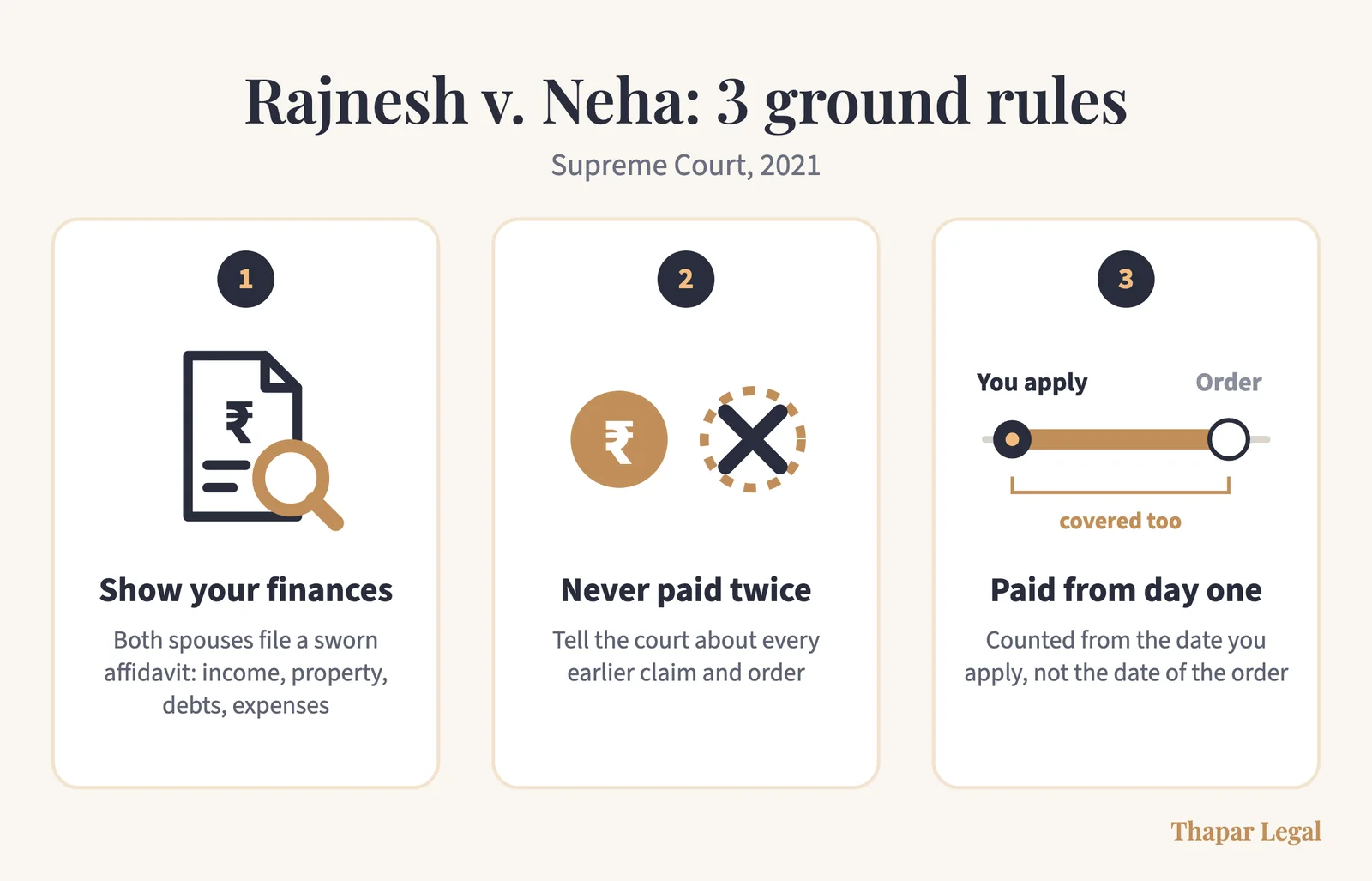
Rule 1: Both sides must show their finances
Arguments like “he earns much more than he admits” or “she is hiding her income” used to be common. Now both spouses must file a sworn statement (an affidavit) listing their income, property, debts and expenses.
This lets the court decide based on documents rather than one person’s word against the other’s. It is also one of the first documents worth discussing with your family law divorce attorney, because what goes into it shapes the rest of your case.
Rule 2: You can use more than one law, but you can’t be paid twice
You can claim under more than one law. But you must tell the court about every earlier claim and order. If you are already receiving maintenance under one order, the court can take that into account or adjust it in a later case.
Before you file a second claim, a family divorce lawyer will usually want to see every earlier petition and order. Keep copies of all of them together in one place.
Rule 3: Maintenance is paid from the date you apply
The Supreme Court said maintenance should be paid from the date you file your application, not the date the court makes its order.
This matters because these cases can take months, sometimes years. You shouldn’t lose support for that waiting time just because the court took a while to decide.
4. How does the court decide maintenance for wife?
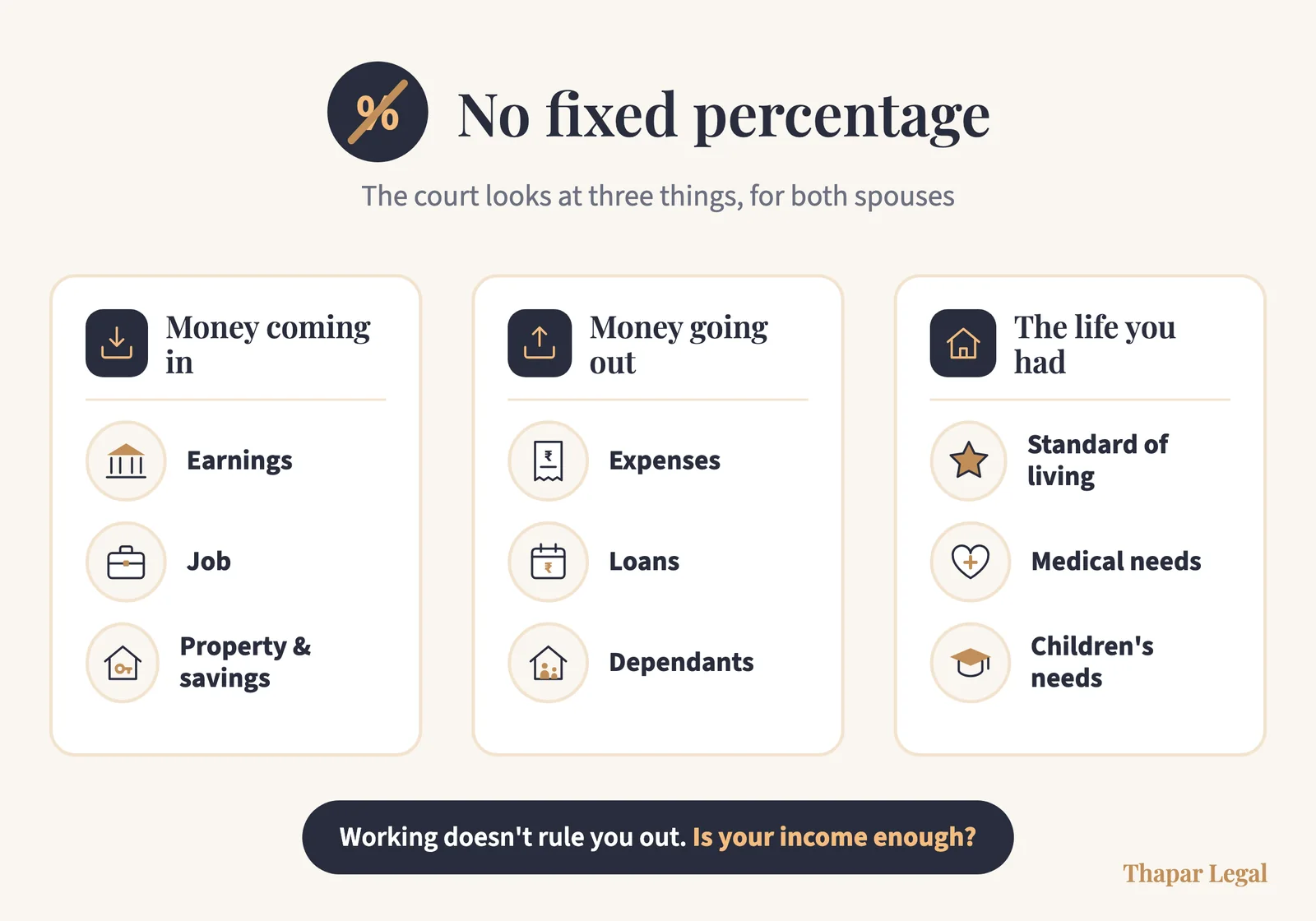
No law sets a fixed percentage of salary. Instead, the court looks at three broad things.
Money coming in
- what each spouse actually earns, and from where;
- each person’s job or profession; and
- any property or savings, including the claimant’s own.
Money going out
- reasonable personal expenses;
- loans and other debts;
- other family members each person supports; and
- any maintenance already being paid under another order.
The life you had and the family’s needs
- the standard of living during the marriage;
- medical needs; and
- the children’s schooling and other needs.
This isn’t a complete list. Rajnesh v. Neha says the court can consider anything else that matters in your particular case.
What if I’m working?
This is one of the most common worries, and one of the most common myths.
“I work and earn ₹45,000 a month. Does that mean I can’t claim maintenance?”
“No. The question is whether your income is enough to support you reasonably, given your circumstances.”
Having a job counts, but it doesn’t decide the matter on its own. And simply saying a spouse “could work” doesn’t settle the question either. The court looks at real circumstances and real evidence.
What if my spouse earns a lot?
“My husband earns ₹2 lakh a month. I want ₹1 lakh as maintenance.”
“His income matters, but the court won’t automatically give you half of it. It will look at your reasonable needs, your own income and property, your children’s expenses, his debts, the life you had together and both of your overall finances.”
The aim is not to punish the spouse who earns more. It is also not to let them avoid a fair obligation by hiding income or overstating debts. The court tries to find a balance that is fair to both.
5. Child maintenance after divorce in India
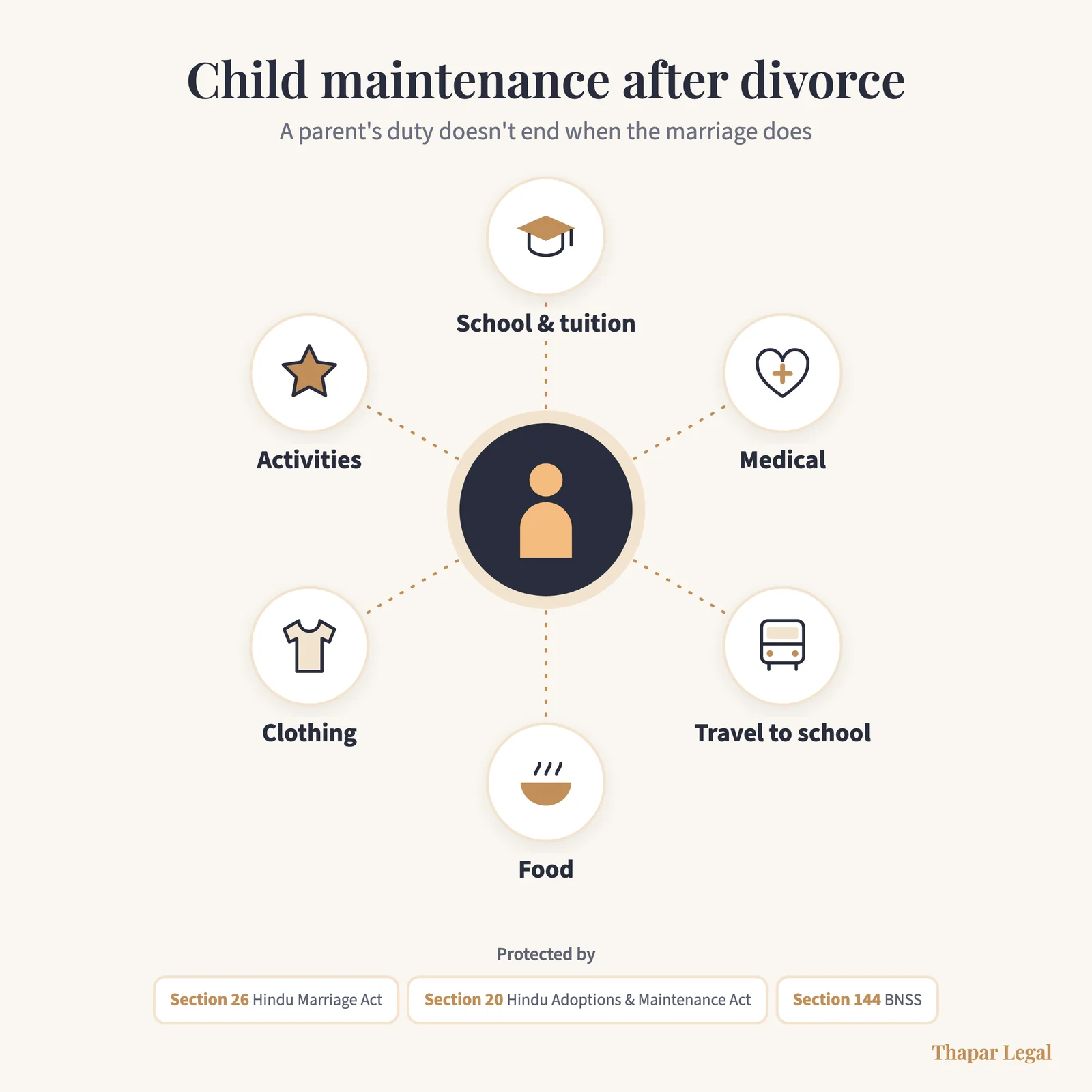
Your child’s right to maintenance is separate from the dispute between you and your spouse. A parent’s duty to support their child doesn’t end because the marriage does.
Several laws protect child maintenance after divorce in India:
- Section 26 of the Hindu Marriage Act lets the court order maintenance and education costs for minor children, during the case and after the divorce.
- Section 20 of the Hindu Adoptions and Maintenance Act says a parent must support their minor children.
- Section 144 BNSS lets a Family Court Judge order maintenance for a child who can’t support themselves.
When working out a child’s needs, the court may look at:
- school fees, tuition and other education costs;
- medical expenses;
- travel to and from school;
- food and clothing;
- activities outside school; and
- any other reasonable expenses that suit the child’s situation.
For example: if your child has always gone to a particular school and the parents can afford to keep that going, the court may take it into account. Child maintenance is not just about bare survival.
6. What documents should you start gathering?
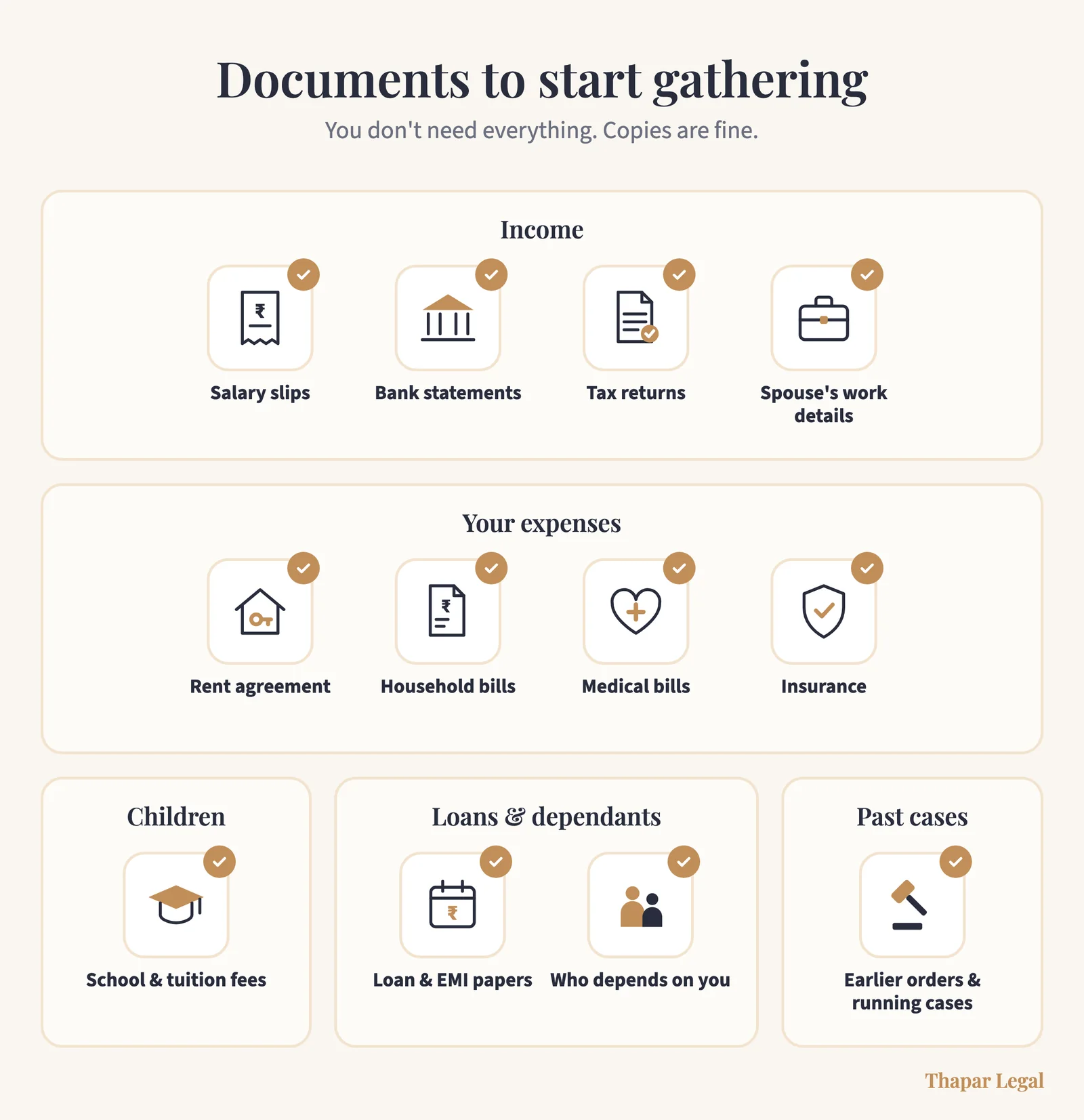
Maintenance cases are decided on evidence. Gather what you can now, even before you speak to a lawyer. You don’t need everything on this list.
Income
- salary slips;
- bank statements;
- income tax returns; and
- anything you know about your spouse’s job, business or other work.
Your expenses
- rent agreement;
- household bills and spending;
- medical bills; and
- insurance payments.
Your children’s expenses
- school and tuition fee receipts.
Loans and dependants
- loan and EMI papers; and
- details of family members who depend on you.
Past cases
- any earlier maintenance orders or cases that are still running.
The aim is not to make your expenses look bigger. It is to give the court an honest, complete picture. A family and divorce lawyer can help you organise these papers so the court sees that picture clearly from the first hearing.
The same applies to the other side. A spouse who hides income or property is likely to damage their credibility with the court.
What to do next
Maintenance in India isn’t a set share of anyone’s salary. And being educated or employed doesn’t automatically rule you out.
The court looks at the real finances of both spouses, what each of you reasonably needs, and what your children need. The rules are spread across several laws, so maintenance for wife and children can be claimed in more than one way. Choosing the right route under India’s alimony laws, and backing it with honest documents, makes a real difference.
So instead of starting with “How much can I get?”, start with three simpler questions:
- Which law fits my situation?
- What documents do I need?
- How should my claim be presented to the court?
Whether you are looking for a family divorce attorney or just want to understand where you stand, speaking to an experienced matrimonial dispute lawyer early can help you answer those questions before anything is filed.
Talk it through with us
Tell us what’s happening. We’ll explain your options in plain words.
This guide is general information about Indian law, not legal advice for your situation. Every maintenance case depends on its own facts.