

Real Estate Lawyer in Gurgaon for Property Disputes, RERA Cases and Advisory
Property disputes involve your home, your savings and often your family. Thapar Legal is a team of real estate advocates in Gurgaon who handle title disputes, builder delays, RERA complaints, partition suits, possession recovery and property documentation, from the first legal notice to the final hearing.

What Our Real Estate Lawyers Handle
Find your situation in the guide, then read how we handle each one below.
Call +91 88000 22288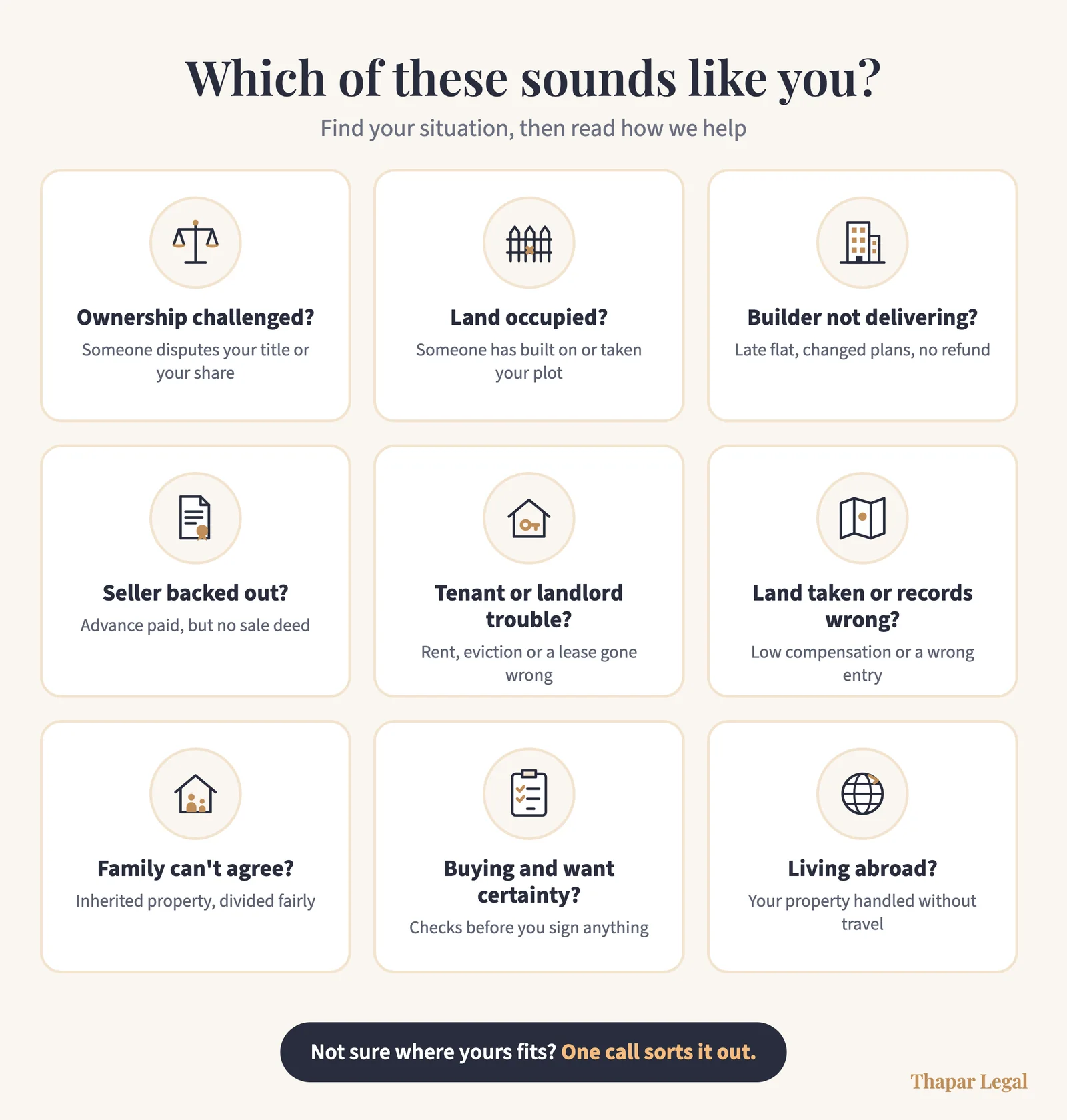
Title Disputes and Partition Suits
When ownership of land or a house is challenged, we trace the chain of title through sale deeds, wills, revenue records and earlier court orders. We file and defend partition suits for ancestral and jointly owned property, so each co-owner's share is decided by a court rather than by pressure.
Encroachment and Possession Recovery
If someone has occupied your land or built on it, we move quickly for an injunction to stop further construction and file a suit to recover possession. Speed matters here: the longer an encroachment stands, the harder it can become to remove.
Builder-Buyer Disputes and RERA Complaints
Delayed possession, changes to the approved plan, poor construction and refusal to refund are the most common complaints against builders. As your RERA lawyer, we file before the Haryana Real Estate Regulatory Authority in Gurugram, or before the consumer courts where that route gives you a better remedy. See the RERA section below for how it works.
Sale Agreement Enforcement and Specific Performance
If a seller takes your advance and then refuses to register the sale deed, the Specific Relief Act, 1963 allows the court to order the seller to complete the sale. We file specific performance suits and defend them, and we act within the limitation period, which is ordinarily 3 years.
Eviction, Tenancy and Lease Disputes
We act for landlords and tenants in eviction suits, unpaid rent, lease termination and illegal occupation, including cases where a licensee refuses to leave.
Land Acquisition and Mutation Disputes
We challenge low compensation and procedural defects in land acquisition, and we correct wrong entries in revenue and municipal records.
Joint Property and Family Settlements
Where family members disagree about inherited property, we negotiate family settlements and draft them so they hold up later, and we litigate when settlement is not possible.
Property Advisory: Title Checks, Registration and Documents
Most disputes are cheaper to prevent than to fight. Before you buy, we verify title and check for pending litigation, encumbrances and approvals. We draft and review sale deeds, agreements to sell, gift deeds, wills, powers of attorney and lease deeds, and we guide you through registration, stamp duty and mutation.
NRI Property Matters
If you live abroad and your property in India is occupied, sold without consent or tied up in a family dispute, our property lawyers can act for you through a properly executed power of attorney, so you do not have to travel for every hearing.
RERA Lawyer in Gurgaon: Builder Delays and HRERA Complaints
The Real Estate (Regulation and Development) Act, 2016 (RERA) was passed to make builders accountable. Most residential and commercial projects must be registered with the state RERA authority, and the builder must deliver what it promised, when it promised.
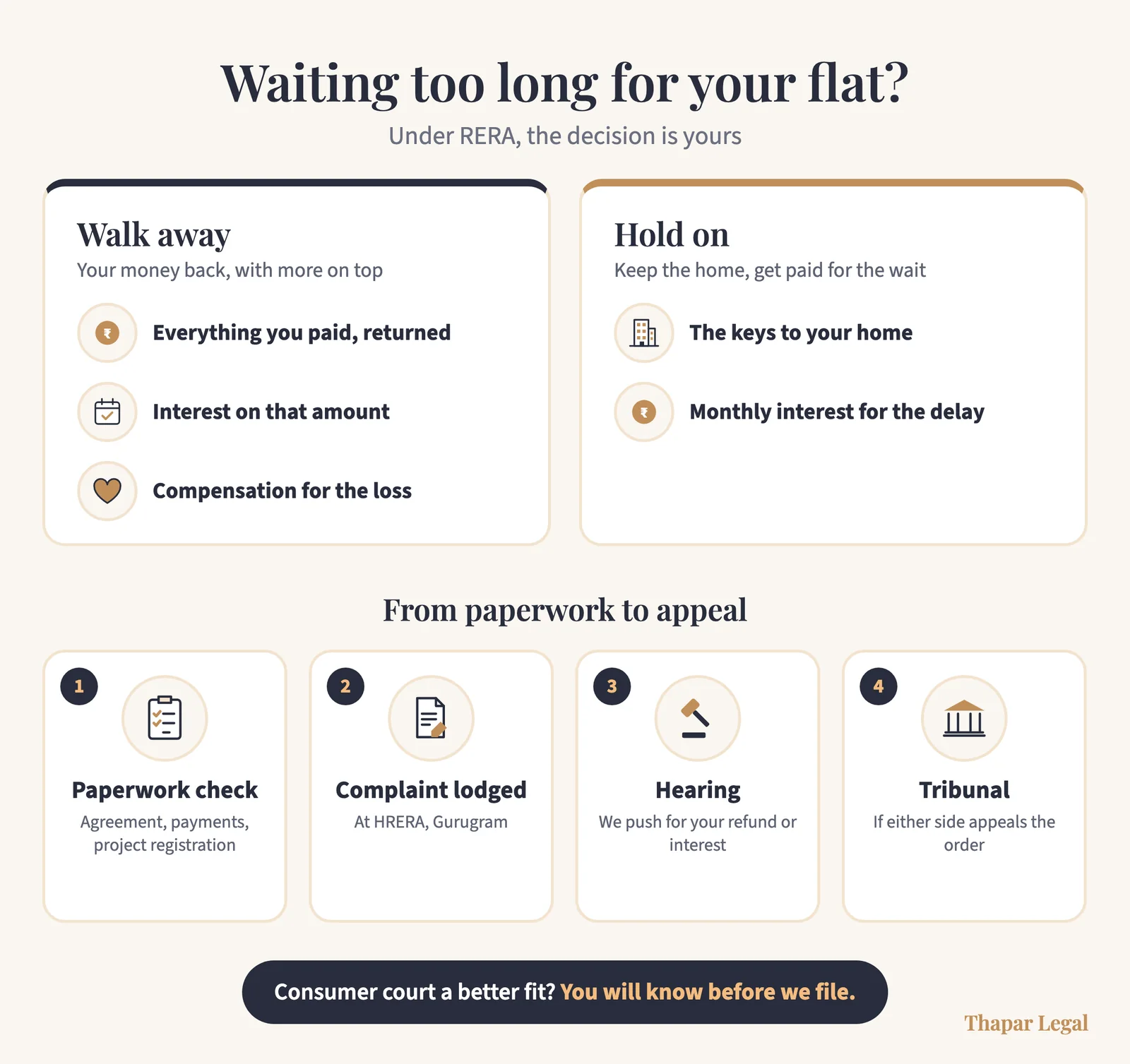
If your builder has delayed possession, RERA gives you a choice:
- Exit the project: ask for a refund of the amount you paid, with interest and compensation; or
- Stay in the project: ask for interest for every month of delay until you get possession.
How a RERA complaint works in Gurgaon:
- We review your builder-buyer agreement, payment receipts and the project's RERA registration.
- We file a complaint before the Haryana Real Estate Regulatory Authority (HRERA) in Gurugram.
- We argue the case and press for the refund or interest the law allows.
- If either side is unhappy with the order, an appeal lies to the Real Estate Appellate Tribunal.
In some cases a consumer court complaint gives a better remedy, for example where you also seek compensation for harassment. Our RERA lawyers will tell you honestly which route suits your case.
How We Resolve Property Disputes
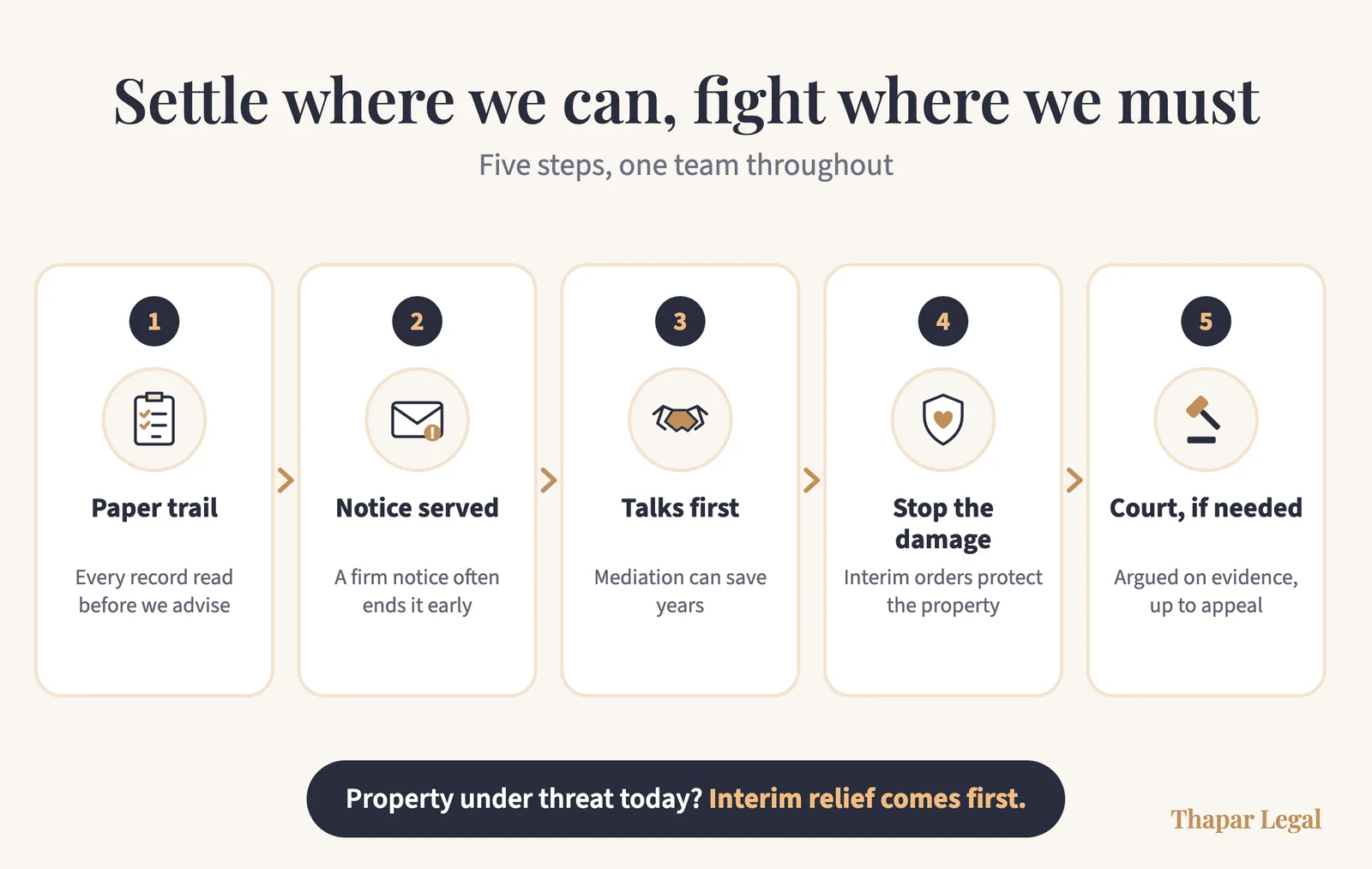
- Review: we study your documents and records before advising on anything.
- Legal notice: a clear notice often brings the other side to the table.
- Settlement or mediation: where both sides are willing, settling saves years. We also handle mediation and arbitration through our ADR practice.
- Urgent protection: if property is at risk of being sold, demolished or occupied, we apply for an injunction to protect it while the case runs.
- Trial and appeal: when court is unavoidable, we argue the case on documents and evidence, through every stage of appeal.
Why Clients Choose Thapar Legal
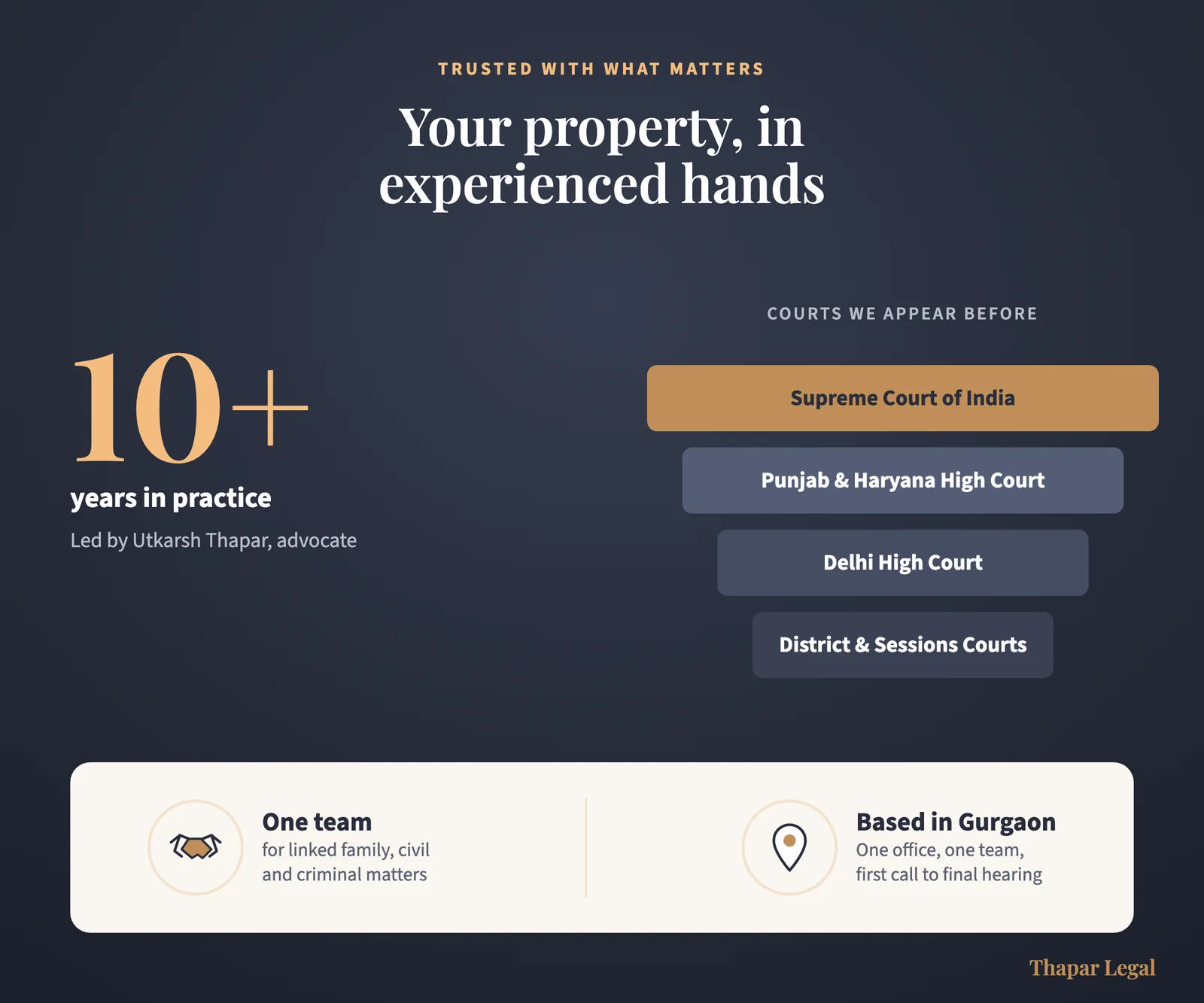
Thapar Legal is led by Utkarsh Thapar, an advocate with over a decade of experience before the District and Sessions Courts, the Delhi and Punjab & Haryana High Courts, and the Supreme Court of India.
- One team for linked cases: property disputes often overlap with family, civil or criminal matters. Our real estate advocates work alongside our civil, criminal and matrimonial teams, so you do not have to coordinate several lawyers.
- Documents first: we build every case on the paper trail, which is where property cases are won.
- Urgent relief: we act quickly where property is at immediate risk.
- Based in Gurgaon: one office and one team, handling your matter from first call to final hearing.
Whether you are searching for a real estate attorney, a property lawyer or a RERA lawyer, you get the same thing from us: clear advice and firm representation.
Frequently Asked Questions About Property Law in India

Can I sue a builder for delay in possession?
Yes. You can file a complaint before the RERA authority, or in some cases before a consumer court, depending on the relief you need. Under RERA you can ask for a refund with interest, or interest for every month of delay if you stay in the project.
What is a transfer of property under Indian law?
Under the Transfer of Property Act, 1882, a transfer happens when a living person conveys property to one or more living persons, or to themselves, now or in the future. "Living person" includes a company or an association of individuals. The Act covers sale, mortgage, lease, exchange and gift of immovable property.
What kinds of property cannot be transferred?
Section 6 of the Transfer of Property Act lists them. They include a mere chance of inheriting property in future, a right to future maintenance, a public office and a mere right to sue.
Is it compulsory to register a property document?
Yes, for most documents that create or transfer rights in immovable property. Section 17 of the Registration Act, 1908 lists the documents that must be registered, and Section 54 of the Transfer of Property Act requires a sale of immovable property worth ₹100 or more to be made by a registered deed. An unregistered document of this kind generally cannot be used as proof of the transfer in court. A document must ordinarily be presented for registration within 4 months of signing; in some cases a further 4 months is allowed on payment of a fine.
Does mutation prove that I own the property?
No. Mutation is an entry in municipal or revenue records for tax and administrative purposes. Ownership is proved by registered title documents, such as a sale deed, or by a court decree.
I have no registered documents. Can I claim ownership?
Possibly, depending on the facts. Long possession, revenue records and other evidence can support a claim in some situations. We review what you have before advising you on the right course.
Can I claim property I have lived on for many years?
Possibly, through adverse possession. Under the Limitation Act, 1963, open, continuous and hostile possession of private property for 12 years, or government property for 30 years, can support a claim. These cases depend heavily on evidence and are decided strictly.
How is ancestral or self-acquired property passed on?
Through inheritance under the Hindu Succession Act, 1956 or the Indian Succession Act, 1925, through a valid will, or through a succession certificate where needed. The revenue and municipal records should then be updated to reflect the new owner.
Is the right to property protected by the Constitution?
Yes. Under Article 300A of the Constitution, no person can be deprived of their property except by authority of law. It is a constitutional right, though no longer a fundamental right.
Can an NRI deal with a property dispute in India without travelling?
In most cases, yes. With a properly executed power of attorney, a lawyer in India can act for you, and many steps can be handled without you being present.